Wednesday, 30 March 2016

Week 6 - Characters

How is the narrative developed through character interactions? 
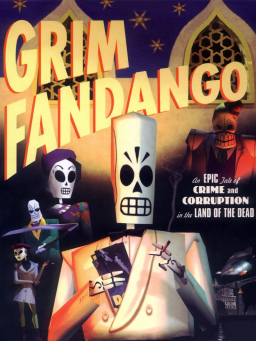
I played the game Grim Fandango REMASTERED you play in a form of a character named Manuel “Manny” Calavera a
travel agent of death. After committing unknown sins when he was alive, he was assigned a job at the Department of Death that involves reaping freshly deceased souls and providing them with a travel package to cross the Land of the Dead. The most luxurious of the packages is Number Nine, a train that takes passengers to the Ninth Underworld,Manny doesn't seem to have luck selling to cheap cilents but then eventually discovers that corruption and deceit surround him, robbing his clients of their travel packages earned through living a good life. This sets off a chain of events that leads him and his good friend Glottis across the entire Land of the Dead, at first merely to save his own butt, but eventually saving those whose paths he crosses.

The narrative is developed through questions you ask characters throughout the game, in the beginning you talk to Eva who is a secretary at the D.O.D
through the conversations she has with Manny, it is made clear that both have been working at the Department of Death for many years and she explains many critical aspects and plot points.

When solving the 'puzzles' within the game you next to communicate with other characters to figure out how to advance to the next arc of the story such as communicating with the demon mechanic Glottis, when you're driver took the rest of the day you walking around to figure out how to get to the poisoning, Glottis then gives you a paper to sign so he'll be able to drive and you try figure out how to get it signed. When breaking into your boss's office to get your paper signed, you find out that your boss Don Copal has been hiding things and doing things that cause suspicious behavior, which furthers the narrative in the game.

Grim Fandango shows a good sense of narrative developments with characters throughout the game unlike the platform game Fez, where not much narrative is established when communicating with characters but instead told to you by what looks like your narrator “Dot”. So Grim Fandango shows a good narrative development with it's interesting characters with memorable personalities.

Thursday, 24 March 2016

Week 5 - CHOICE


How does morality influence the choices you make in the game?


In the game The Wolf among us, morality plays an important role in the game with Bigby, the Big Bad Wolf, who is the sheriff of the town who is the character you play as throughout the game, has the potential to be extremely good and extremely bad. In the first play-through i tried to meet the middle with both good and bag. The reason I chose that decision was because i wasn't aware of the morality until watching other game-plays and if Bigby was cynical enough he'd release his "Big Bad Wolf" mode at a point in the game. I played The Wolf Among Us as if i was the character, the decision that i had made were met in the middle but i would defend myself if there were attacks, it left an unsatisfying feeling through the game-play. So i decided to play more cynical the results were very intense and he was "back to his old ways" choosing to be cynical can affect your relationships with your 'friends' and other members of Fabletown, like for example there was a scene where Bigbys pig friend Colin was at his apartment, you are given a choice whether or not that you will give him a drink, I chose to be a jerk and drink it instead. From that choice, Colin would remember it in the future. Another example would be in the beginning where you talk to Toad, that's the first narrative interaction you have with character in the game, what you say ultimately affects Toads interaction with you in the rest of the game and he'd remember it, such as I told him if he didn't put his glamour on he'd be sent back to the farm, a few scenes later you give him an inch of niceness Toad walks over you bringing up the last conversation you had, Toad trying to bring you down a peg.  The morality of following the rules as opposed to following your instincts is challenged in this game, it happens multiple times if you do exactly what Snow White says in order to appease her, which is basically the law, you're called her 'lap dog'. and you're not who you're ultimately should be, where it's also a theme within the game, where it's your choice whether or not your want to be pragmatic or cynical can effect your identity and how the characters perceive Bigby.   

Wednesday, 23 March 2016

Week 5 - Major Projects


These are the long shots Levi and I worked on this week for our animation.


This is the one i'll be working on during the weekend.

Wednesday, 16 March 2016

Week 4 - CHOICE

Game: The Wolf Among Us


Do the choices made in the game result in branching narrative paths? If so, how? If not, how are the choices meaningful?

I played the game The Wolf Among Us, during the game play you are given the assumption that the game has branching narrative paths because the way the game let's the player make choices in their actions or through conversation trees that will influence future events in the story, including events in future episodes. These include major decisions, such as deciding which of two culprits to chase after while allowing the other to go free.

I think the game choices are meaningful because out of the four piece dialogue to choose from can deeply affect the relationship with the person you're talking to, such as at the beginning of the game I the player decided to make the main character Bigby not give Bourbon to his pig friend Colin. From that result Colin, will remember it for the rest of the game and Colin and Bigbys relationship is now strained. For the quick-time events if you don't decide to think on the spot fast enough it'll result in your death which gives you the motivation to give meaningful choices in-game.

Through out the game you're given a lot of choices but eventually it leads up to one major point of the story no matter how branched off you are and you how you affect your relationship with other characters you are still forced on the main story node, unlike Fallout 2 where it's opened world. In the end, you are given two outcomes on the ending of The Wolf Among Us but the same Epilogue in the story. The Wolf Among Us is a telltale game, so it's unexpected for it to off-rails no matter what you decide while playing it but mainly results in the characters death if the player does so. So this storytelling game has narrative paths but in the end you have one ending you're meant to reach. 

Week 4 - Major Projects


Did some look frames for our animation this week.

Wednesday, 9 March 2016

Week 3 - Major Projects


I did colour schemes for Levi's concept sketches for our animation project.

Week 3 - Level Design

Did linear storytelling in your chosen game engage and excite you as a player? Explain why or why not. 


I found Never Alone engaging because it gave you parts of a story which makes the player interested in what the bigger story is. Every time you'd complete a fast paced level, a cut scene would play giving you some information on what was going to happen next. I found it pretty fun going through the levels while I played but the storytelling didn't really excite me because there wasn't really a story being told while you played the game only until the cut scenes. So it was pretty much from going to point A to B then getting a story. The story itself was based on a Inuit legend which games rarely use as a main narrative, so that was the first thing that interested me but continuing on in the game it became kind of boring. Never Alone didn't really follow the three arc story structure which I enjoyed but instead decided to keep adding to the story, for example such as when the main character Nuna has to verse the Manslayer you assume that he is the main villain because he takes up the majority of the game and also wanting to obtain the weapon you hold that might be significant to the story, but that's not the case and you realise that the final boss isn't what you except as you assume while playing, the weapon you have and your relationship with the fox you think it leaded up to the point where everything was explained, but it wasn't so it was kind of disappointing to me in the end.

Wednesday, 2 March 2016

Week 2 - Interactive Narratives and Game Studies

             Interactive Narratives and Game Studies


How does your chosen game tell its story? Is it successful?

I played the game Her Story an interactive movie game, the way that the story was told was snippets of footage of a woman interviewed by the police. Her Story's main game mechanic is basically a search engine in the computer. In pieces of the footage in the woman's interview she would say a buzzword or a keyword within her statement,The player's job was to find and organised the footage in the right order with the of the timestamps in the footage to uncover the truth and the mysterious background story of the character. It is successful due to the intrigue of the characters story giving a sense of mystery and drama, the interactions of the computer screen, like the old messaging systems and the theories that develop around it.This game makes you believe that you are a detective trying to solve this mystery and wanting the answer. The ending makes your mind explode but you're satisfied with all the effort you put into it.

I believe it was successful because when i played it it was believable to me, and it was engaging to play, if you get passed the overall beginning, you eventually invest hours into the game and the plot twists you discover throughout the game leaves you speechless